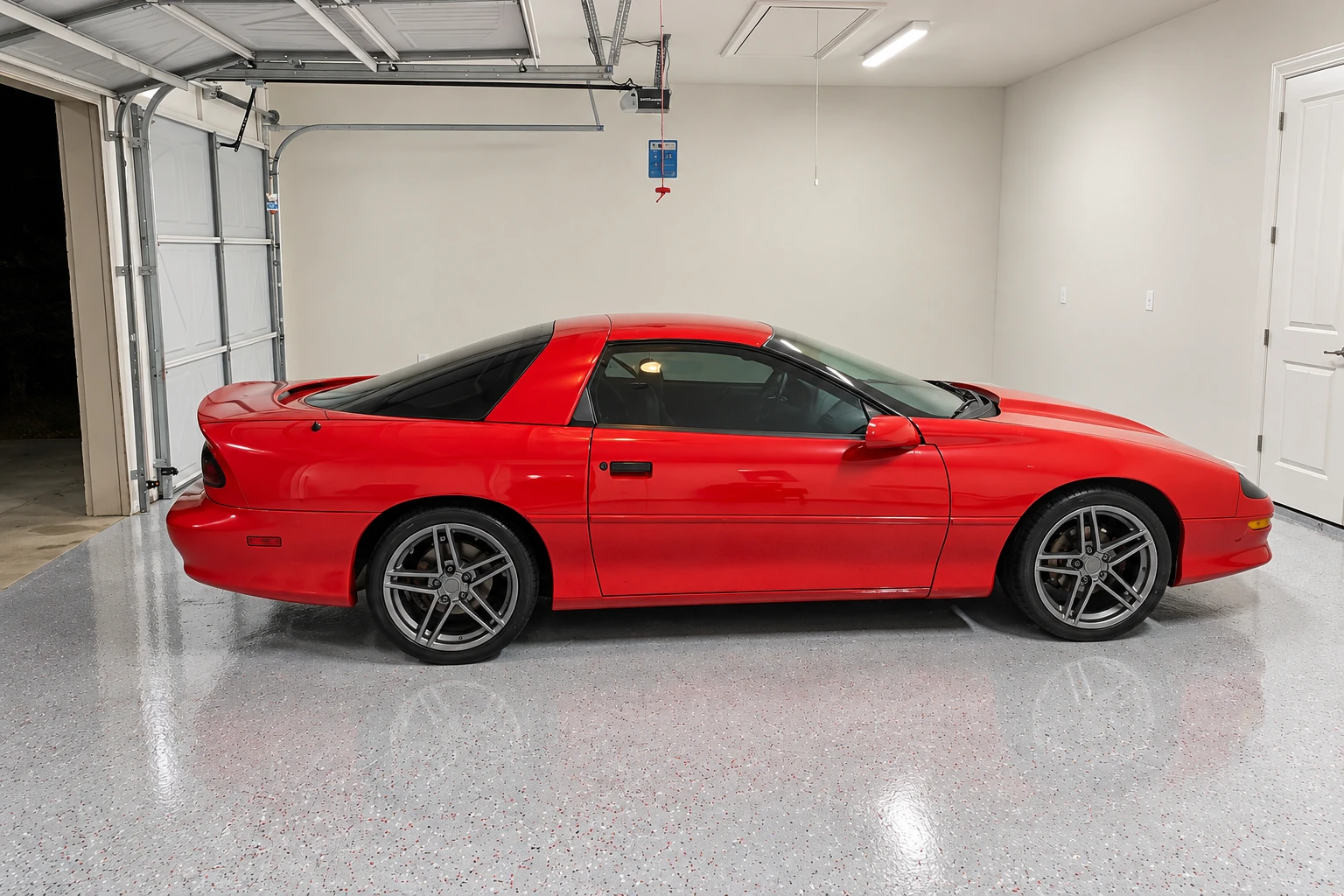
I start by asking how you'll use the garage and whether you plan to coat or seal the floor down the road, because that changes what goes under the slab before we pour, so it helps to tell us early. If there's an old floor, we break it out and haul it away. Then our crew digs out the subgrade, the dirt the slab sits on, and packs it firm, because a base that's only raked level settles and takes the concrete down with it. We set the forms so the floor falls toward the door and water runs out instead of back toward the house, and we add rebar, the steel bars that hold a slab together, where the job calls for it. We pour early in the day, since a slab finished in midday heat can end up with a weak, dusty top. Once it's finished, we cut control joints, shallow grooves that give the slab a straight line to crack along, while the concrete is still young, before random cracks can pick their own spots. Then we keep it damp and covered while it cures, which is how it gains strength before it takes the weight of a car. If a budget gets tight, the base is the last place I'd trim, because nobody sees it on day one and it's the part that decides how the floor holds up.
A garage floor rarely sits on its own. If you'd like color or a pattern instead of plain gray, our decorative concrete work can carry that look into the garage or the approach outside it. When the garage sits into a slope and the ground beside it needs holding back, we build concrete retaining walls so the dirt stays put and doesn't wash onto the new slab.
Replacing a cracked or sunken garage floor
This suits an older garage where the slab has cracked through, dropped at a corner or started chipping. We break it out, fix the ground underneath, which is usually the real cause, and pour a new slab instead of patching over a problem that keeps moving.
A floor you plan to coat or seal later
This suits a garage that's headed toward being a workshop, a gym or a clean showroom floor with a coating on top. We plan the moisture protection under the slab before the pour, because it's far easier to build in now than to fix once a coating is down.